

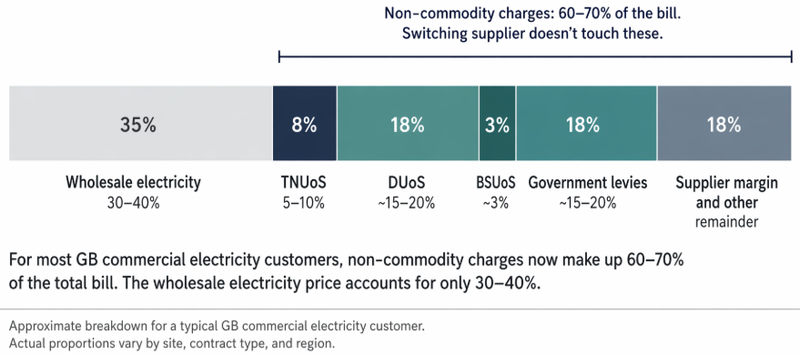
Over 60% of a typical commercial electricity bill in GB is made up of non-commodity charges, like: network costs, system charges, and policy levies. TNUoS charges, which account for 8% of the total costs, rose by approximately 60% from April 2026.
While some of these charges are fixed, you have scope to reduce others depending on how and when you use electricity. In this article, discover the different types of non-commodity charges and which ones your site can actually bring down.
What electricity non-commodity charges are
Your electricity bill is made up of two parts. The commodity part is the wholesale price of the electricity itself, and that's what changes when you switch suppliers.
The non-commodity part covers everything else:
- Network costs
- System charges
- Government levies
- Policy costs
Your supplier collects them, but doesn't set them. They're actually determined by bodies like NESO (the National Energy System Operator), regional Distribution Network Operators (DNOs), and government policy.
For most GB commercial sites, the non-commodity part now makes up over 60% of the total bill. That means switching suppliers only addresses about a third of what you're paying.
How these charges appear depends on your contract. If you're on a pass-through deal, which is common for larger sites on half-hourly meters, each charge shows up as a separate line and any increase hits your bill immediately. If you're on a bundled contract, they're folded into your unit rate and standing charge, so you don't see them individually.
The four main charges on a GB commercial electricity bill
The four main charges on a GB commercial electricity bill are:
1. TNUoS (Transmission Network Use of System)
TNUoS is the biggest fixed charge on most commercial electricity bills and, for the most part, there's nothing you can do about it.
Over 90% of it is a daily standing charge based on your site's banding, which is set by your connection voltage and agreed supply capacity. It hits your bill every day regardless of how much electricity you use.
Definition of connection voltage: How your site connects to the grid. Smaller sites connect at low voltage, larger sites at high voltage (HV) or extra-high voltage (EHV). Higher voltage means a more expensive TNUoS band.
Definition of Agreed Supply Capacity: The maximum power your grid connection can deliver, set when your site was first connected. If your site uses less power now than it did then, this figure could be too high, which puts you in a pricier band than you need to be.
A smaller locational element, based on peak demand, varies by region and you can reduce that by changing when your site uses the most electricity. But it's a few percent of the total so the level of savings will be small.
TNUoS rose by approximately 60% from April 2026, with the TNUoS charges 2026 increase hitting some bands harder than others. Further rises are forecast through 2030/31. Understanding how TNUoS is calculated helps you check whether your band is right.
Can you influence it? Mostly no. You can manage peak demand to reduce the small locational element, but the daily standing charge is fixed.
2. DUoS (Distribution Use of System)
DUoS funds the cables, substations, and transformers run by regional DNOs that deliver power from the transmission grid to your building. This is the local distribution network.
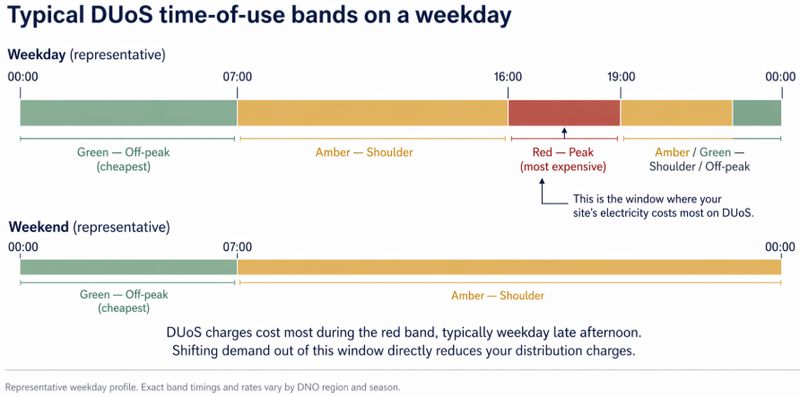
This is the charge you can actually do something about. DUoS uses three time-of-use bands:
- Red (peak, most expensive): typically weekday late afternoon, roughly 4–7pm
- Amber (shoulder periods)
- Green (off-peak, cheapest): overnight and weekends
The red-band rate can be several times higher than the green-band rate. If your site can shift battery charging, heavy equipment, or other flexible loads out of the red band and into green, the saving is real, it repeats every day, and it's far bigger than anything you can do on TNUoS.
DUoS also has a fixed standing charge element to it, but the time-of-use bands are where the savings are.
One thing to be aware of is that the exact band timings and rates are set by your regional DNO, so they vary by location. Regardless, the principle wherever you are is that peak usage costs you more.
DUoS rates are expected to rise from April 2028 as distribution networks invest in capacity for EV chargers, heat pumps and increased electrification. The sites already managing when they use the most electricity will absorb that increase more easily than those that aren't.
Can you influence it? Yes. The time-of-use element responds directly to when your site uses electricity. This is the most responsive network charge on your bill.
3. BSUoS (Balancing Services Use of System)
BSUoS covers the cost of keeping supply and demand in balance across the grid. It's been a fixed per-kWh charge since April 2023 and makes up about 3% of a typical business electricity bill.
Can you influence it? No.
4. Government levies and policy charges
On top of the network charges, your bill includes government levies that fund renewable energy schemes, nuclear investment, and climate policy. Your supplier passes them through, often without showing them as separate lines.
The seven main levies and charges are:
| Levy | What it funds | Can you influence it? |
|---|---|---|
| RO (Renewables Obligation) | Older renewable energy projects like wind and biomass. The scheme is closed but you're still paying for it | No |
| FiT (Feed-in Tariff) | Payments to small-scale solar and wind installations. Also closed, still on your bill | No |
| CfD (Contracts for Difference) | New renewable energy projects like offshore wind. This is how the government funds large-scale renewables now | No |
| CCL (Climate Change Levy) | A tax on the energy your business uses | Partial: 80–92% relief with a Climate Change Agreement |
| CM (Capacity Market) | Pays power stations and storage to be available when demand is highest | No |
| Nuclear RAB Levy | The construction of Sizewell C nuclear power station | No |
| EII (Energy Intensive Industries) Support Levy | Subsidises energy costs for heavy industry, so you're paying for their discount | No |
The one worth checking on is the Climate Change Levy (CCL).
If your business has a Climate Change Agreement with the Environment Agency, which means you've committed to energy efficiency targets, you can get 80–92% relief on the levy. Most standard commercial sites won't qualify, but if you're in manufacturing or another energy-intensive sector, ask your energy supplier or accountant whether a Climate Change Agreement applies to your business.
Can you influence them? For most businesses, no. These are set by government policy.
Your non-commodity charges at a glance
Here's a breakdown of your non-commodity charges:
| Charge | Fixed or responds to site behaviour? | What determines the cost |
|---|---|---|
| TNUoS residual | Fixed | Based on your banding (voltage + agreed capacity) and charged daily whether you use electricity or not |
| TNUoS locational | Partly responds | Based on your peak demand during triads (half-hourly metered sites) or 4–7pm weekdays (non-half-hourly metered sites) |
| DUoS time-of-use | Responds | Based on when you use electricity with peak periods costing the most and off-peak the least |
| DUoS fixed element | Fixed | A standing charge based on your connection |
| BSUoS | Fixed | A flat per-kWh tariff, unchanged since April 2023 |
| Government levies | Fixed | Set by government policy, though some businesses qualify for CCL relief |
What this means for sites with batteries, solar, and flexible assets
Below, find five practical actions to bring down the parts of your electricity bill that aren't fixed.
| Action | Which charges it affects | How |
|---|---|---|
| Shift demand out of DUoS peak periods | DUoS time-of-use | Your battery discharges during the expensive afternoon peak and recharges overnight when rates are lowest. Your distribution charges come down |
| Reduce grid import during triads / 4–7pm | TNUoS locational | You draw less from the grid during the periods that set your locational charge. The saving is small on its own but adds up alongside DUoS and import savings |
| Charge battery at cheapest import periods | Commodity (wholesale) cost | Your battery charges when electricity is cheap and discharges when it's expensive, so you pay less for every kWh on average |
| Store solar for peak-period use | Commodity cost + DUoS | Instead of exporting solar power at a low rate, you store it and use it during the most expensive part of the day |
| Trade battery capacity in wholesale and balancing markets | None directly. Adds revenue | Your battery earns income by selling stored power when wholesale prices are high. It doesn't bring any single charge down, but it improves what you pay overall |
A building energy management system coordinates all five of these automatically.
How GridVolt can help reduce your commercial electricity bills
Nobody can change the fixed charges on your bill, but these two services bring down the costs you can:
- Energy Manager: Software that controls when your batteries, solar, and EV chargers charge and discharge based on your actual tariff, so you pay less for the same electricity.
- GridTrade: Earns trading revenue from your battery by selling stored power when wholesale prices are high, without you having to switch suppliers.
Your supplier controls a third of the bill. You control the rest. Work with us to find out what your site could save. Contact GridVolt for a compatibility check and a site-specific review of your tariff, load profile, and existing assets. If we can cut your energy costs, you’ll see how much before you commit to anything.