

From April 2026, many GB businesses saw their electricity standing charges jump by more than 60%, even though their energy usage had not changed. The main driver behind this jump is TNUoS (Transmission Network Use of System) charges, which are the fees that fund the high-voltage electricity grid.
Although TNUoS is not a new charge, the scale of the April 2026 increase caught many businesses off guard. In this article, we explain how the charge works, including how to tell which parts of the charge your site can influence and what to do about the rest.
What is TNUoS?
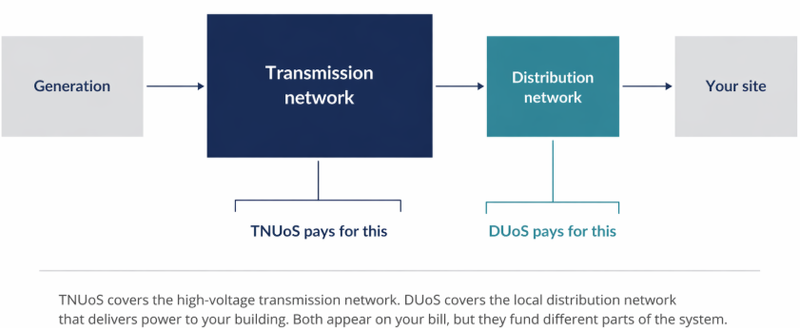
TNUoS charges pay for the high-voltage transmission network. Specifically, that includes the pylons, cables, and substations that carry electricity from power stations and wind farms to the local distribution networks that serve individual buildings. It’s like the motorway system for electricity, before it reaches the local roads.
TNUoS charges cover the transmission network across England, Wales, Scotland, and offshore. For commercial sites, that means any business connected to the GB electricity network pays them. The charge exists because the transmission network costs money to build, maintain, and upgrade. They don’t apply in Northern Ireland, which operates under a separate electricity market and network charging structure.
NESO (the National Energy System Operator) sets TNUoS tariffs, meaning your supplier doesn’t control the rate. NESO is the public body that operates the GB electricity system, independent of energy suppliers and transmission owners. This role was previously held by National Grid ESO.
TNUoS is a pass-through cost from NESO to you. It’s not optional, you can’t negotiate your own rate, and you can’t avoid it by switching suppliers.
TNUoS charge vs DUoS charge vs BSUoS charge
TNUoS is separate from DUoS (Distribution Use of System), which pays for the local network that delivers power to your building, and from BSUoS (Balancing Services Use of System), which pays for keeping supply and demand in balance on the grid.
These are all non-commodity charges — the costs on your electricity bill that have nothing to do with the price of the electricity itself. For most businesses, non-commodity charges now make up more than half the total bill.
All three appear on your bill, but TNUoS and BSUoS are fixed. DUoS is the only one that costs you more when you use electricity at the wrong time of day. That makes it the only network charge worth changing your site's behaviour for.
The fixed part and the part you can influence
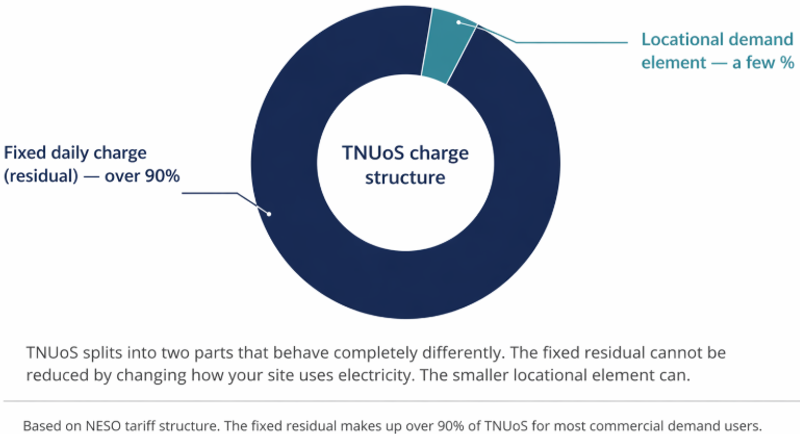
There are two parts to the TNUoS charge. One is fixed. The other one you can reduce by using less electricity at peak times.
The fixed residual
The Transmission Demand Residual is the majority of a TNUoS charge, accounting for 90% of the total cost for businesses. It’s a fixed daily standing charge, quoted as £/site/day. You pay this, even if your site uses no electricity at all.
The size of your residual depends on two factors:
- The voltage level of your connection (low voltage, high voltage, extra-high voltage, or transmission)
- Your agreed supply capacity or consumption level.
Higher voltage levels and higher supply capacities mean a higher daily charge.
You can’t reduce your residual by using less electricity, shifting demand to off-peak periods, or installing a battery. A site that halves its electricity consumption still pays the same daily residual charge.
You may be able to reduce your residual if your agreed capacity is higher than it needs to be. In this case, you should ask your supplier or DNO to review it. If your agreed capacity comes down, your band drops with it and so does the daily charge.
NESO fixes the bands for five years at a time. The current set (RIIO-ET3) runs from April 2026 to 2031, so whatever band your site is in now, it stays there until 2031 unless your connection changes.
The residual cost varies widely. A small commercial site on a low-voltage connection pays a few pence per day, and a larger half-hourly metered site on a standard commercial connection could pay several pounds per day. At the top end, large EHV and transmission-connected sites pay thousands of pounds per day.
The locational demand element
The locational element is the smaller part of TNUoS, typically a few percent of the total. Unlike the residual, this part goes up the more electricity you use at peak times.
The way it is calculated depends on whether your site has a:
- Half-hourly meter: Your charge is based on your demand during the three triad peaks each winter. Triads are the three half-hours between November and February when national electricity demand is at its highest, like cold, dark weekday evenings when heating, lighting, and industrial loads all peak at once. The problem is you don’t find which half-hours were the triads until winter is over, meaning it’s tough to predict.
Non-half-hourly meter: Non-half-hourly meter charges are based on how much electricity you use between 4pm and 7pm on weekdays across the year.
| Half-hourly metered sites | Non-half-hourly metered sites | |
|---|---|---|
| What's measured | kW demand at triad peaks | kWh consumed 4–7pm weekdays |
| When it matters | Three half-hours, Nov–Feb | Every weekday, year-round |
| Known in advance? | No — confirmed after the event | Yes — fixed time window |
Locational charges also vary across 14 demand zones in GB. Zones closer to major generation sources (Scotland, northern England) have lower or zero locational charges, while zones further from generation (southern England) pay more. This reflects the cost of moving power south.
Why TNUoS charges are rising
TNUoS charges are rising to pay for upgrades to the GB transmission network.
The main driver is the government's target to decarbonise the electricity grid by 2030. This has accelerated investment in new transmission lines, substations, and undersea cables to connect offshore wind farms to the rest of the grid.
The challenge is that most of this new generation is in the north and off the coast, but the greatest demand for electricity comes from the south. Moving that power requires infrastructure on a scale the network has not seen in decades.
Ofgem confirmed the figures in its final determination in December 2025, approving £46.2bn in revenue for transmission owners over the five years from 2026 to 2031. That money is recovered through TNUoS.
Total TNUoS revenue rose from approximately £4.3bn in 2025/26 to £7.61bn in 2026/27, an average increase of 60–64% across all demand users. Some individual bands saw rises of over 100%.
This is not a one-year spike.
NESO's five-year forecasts project further increases through 2030/31, with total TNUoS revenue potentially reaching £13.6bn. The next five-year view update is due by September 2026. Plan on the assumption that network costs will keep rising for the rest of the decade.
The rise in 2026 TNUoS charges hit some bands harder than others, with the steepest rises at the HV and EHV level.
How TNUoS appears on your bill
How TNUoS shows up on your electricity bill depends on the type of contract you have with your supplier. There are two main types:
- Bundled contracts: TNUoS is rolled into your overall standing charge and unit rate, so you don't see it as a separate line item. Your supplier estimates what the TNUoS will be when they price the contract and builds it in. If they underestimated the April 2026 increase, they’ll either absorb the difference or adjust your charges mid-contract, depending on your terms.
- Pass-through contracts: TNUoS appears as a separate charge on your bill at the actual NESO tariff rate. The supplier passes it straight through to you, usually with a small administration charge. On these contracts, the April 2026 increase appeared directly on bills from April. There is no buffer and the supplier will not absorb it.
| Bundled contract | Pass-through contract | |
|---|---|---|
| How TNUoS appears | Built into standing charge and unit rate. No separate line item | Separate charge on your bill at the NESO tariff rate |
| Who carries the cost risk | Supplier estimates TNUoS at contract start. Absorbs or adjusts if wrong | You pay the actual tariff directly |
| April 2026 impact | Depends on contract terms. May be absorbed or adjusted mid-contract | Appeared on bills from April with no buffer |
| Typical for | Standard commercial contracts | Larger businesses, HH metered sites |
Many businesses assume a "fixed" energy contract means every part of the bill has been locked but that’s not true for TNUoS. Check your contract terms for these phrases:
- "Pass-through charges"
- "Third-party charges"
- "Non-commodity costs"
See any of those and it means your supplier can adjust TNUoS mid-contract even if the unit rate is fixed. Several suppliers have already confirmed they are passing through the April 2026 TNUoS increase to existing customers.
If you are not sure how your contract treats TNUoS, ask your supplier directly. The answer tells you whether the increase has already affected your bills, is coming on renewal, or has been absorbed.
What a commercial site can actually do
You may have seen adverts from, or been approached by, consultants offering to reduce your TNUoS or your network charges. Any savings they secure will be minimal because the part of the charge they can influence is a very small part of the overall total.
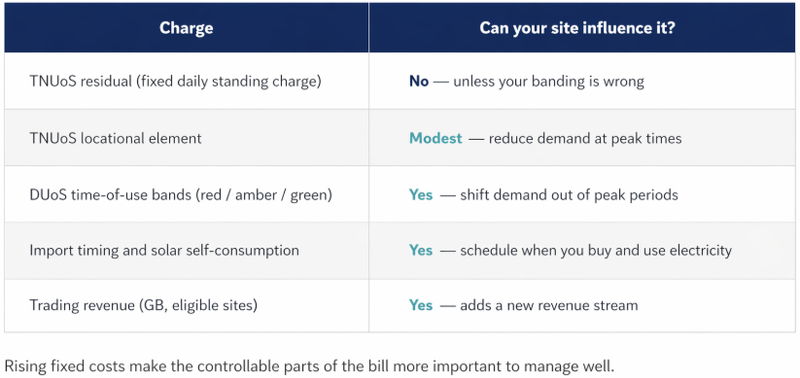
But with prices rising, it’s worth checking out your options. Your four best options are:
1. Check your banding and agreed capacity
Understanding how TNUoS is calculated helps you check whether your band is right. If the supply capacity you agreed on is higher than your site’s peak demand, you may be on too high a residual band.
This happens more frequently than you might expect because demand doesn’t reach the expected levels set at the time of the original connection or your site was over-specified. Review your agreed capacity with your supplier or DNO. If it comes down, your band drops and your daily TNUoS charge drops with it.
If your site already has a battery that peak shaves, your actual maximum demand from the grid could be well below your Agreed Supply Capacity. That's worth raising with your DNO when you request a review.
2. Manage your peak demand
For half-hourly metered sites, using less electricity during triad peaks reduces your locational TNUoS charge. You may save even more on DUoS, because peak demand affects that charge too.
DUoS charges are split into three time bands:
- Red (peak, most expensive)
- Amber (shoulder)
- Green (off-peak, cheapest)
The more electricity you use during red band periods, the more you pay. If you can shift usage out of the red band, your DUoS costs come down.
One way to do that is with a commercial battery storage system. It can discharge during red band periods so your site draws less from the grid, then recharge during cheaper green band periods. Doing both reduces your locational TNUoS charge and your DUoS costs at the same time.
3. Improve solar self-consumption and import timing.
If your site has solar panels, store the electricity they generate in a battery for use during expensive periods, rather than exporting at a low rate to save money.
Even if you don’t have solar, scheduling battery charging for off-peak periods when import prices are lowest and discharging when prices are highest cuts the average cost of every kWh you draw from the grid.
The difference between a battery on a fixed timer and one controlled by a building energy management system that responds to actual tariff data can be significant. You use your existing hardware but get materially different commercial results .
4. Consider trading revenue
So far, the focus of the article has been on reducing electricity costs. Trading revenue generates income for your business. Wholesale electricity prices change throughout the day, and a battery can earn revenue by selling stored power when prices are high and recharging when they drop.
Not every site is eligible. You typically need a battery of around 100kWh or more, a half-hourly meter, and a profile class 00 connection. If your site qualifies, you can trade battery capacity in wholesale and balancing markets without switching energy supplier. This has been possible through third-party providers since the P415 rule change in November 2024.
Trading revenue does not reduce TNUoS. But it does create a new income line that improves overall site economics and accelerates battery payback in an environment where fixed network costs are rising.
How can GridVolt help?
GridVolt can't cut your TNUoS residual as it’s fixed. But we can reduce the costs around it and, for eligible sites, add a revenue stream on top. Our two main services are:
- GridTrade: Earn trading revenue from wholesale and balancing markets and stay with your existing supplier.
- Energy Manager: Software, compatible with most batteries, that decides when to charge, discharge, and import based on your actual tariff, so you pay less for the same electricity.
Contact GridVolt for a compatibility check and a custom review of your tariff, load profile, and existing energy assets, including solar panels and battery storage. We'll let you know what the savings and revenue potential look like on your specific site.
Frequently asked questions
What does TNUoS mean?
TNUoS stands for Transmission Network Use of System. This is a charge every business connected to the electricity network across England, Wales and Scotland pays to fund the infrastructure that transports electricity from generators to local distribution networks.
What is the difference between TNUoS and DUoS?
TNUoS charges pay for the infrastructure of the national transmission network, while DUoS charges pay for the local distribution network, the cables, substations, and transformers that deliver power from the transmission grid to your building.
Do batteries reduce TNUoS charges?
If your site has a battery that peak shaves (meaning it delivers stored power during busy periods so the site never pulls more than a set amount from the grid), you may be able to make the case that your Agreed Supply Capacity is too high. If your DNO agrees to reduce it, your band drops and so does the daily residual. The battery isn't reducing the charge directly but changing the input that determines which band you're in.
What is the difference between TNUoS and BSUoS?
TNUoS charges pay for building and maintaining the electricity transmission network, while BSUoS charges pay for keeping supply and demand in balance on the grid, and account for approximately 3% of a typical business electricity bill.
Can I negotiate TNUoS charges?
No. TNUoS tariffs are set annually by NESO and passed through by suppliers. You cannot negotiate them individually or shop around for a lower rate. But if your site uses less electricity than expected, it's worth checking whether your agreed capacity still matches your actual demand. If it's too high, you could be paying a higher daily charge than your site needs to be on. Ask your supplier or DNO to review it.